Loan Officers
7 Tips for Closing in a High Rate Environment
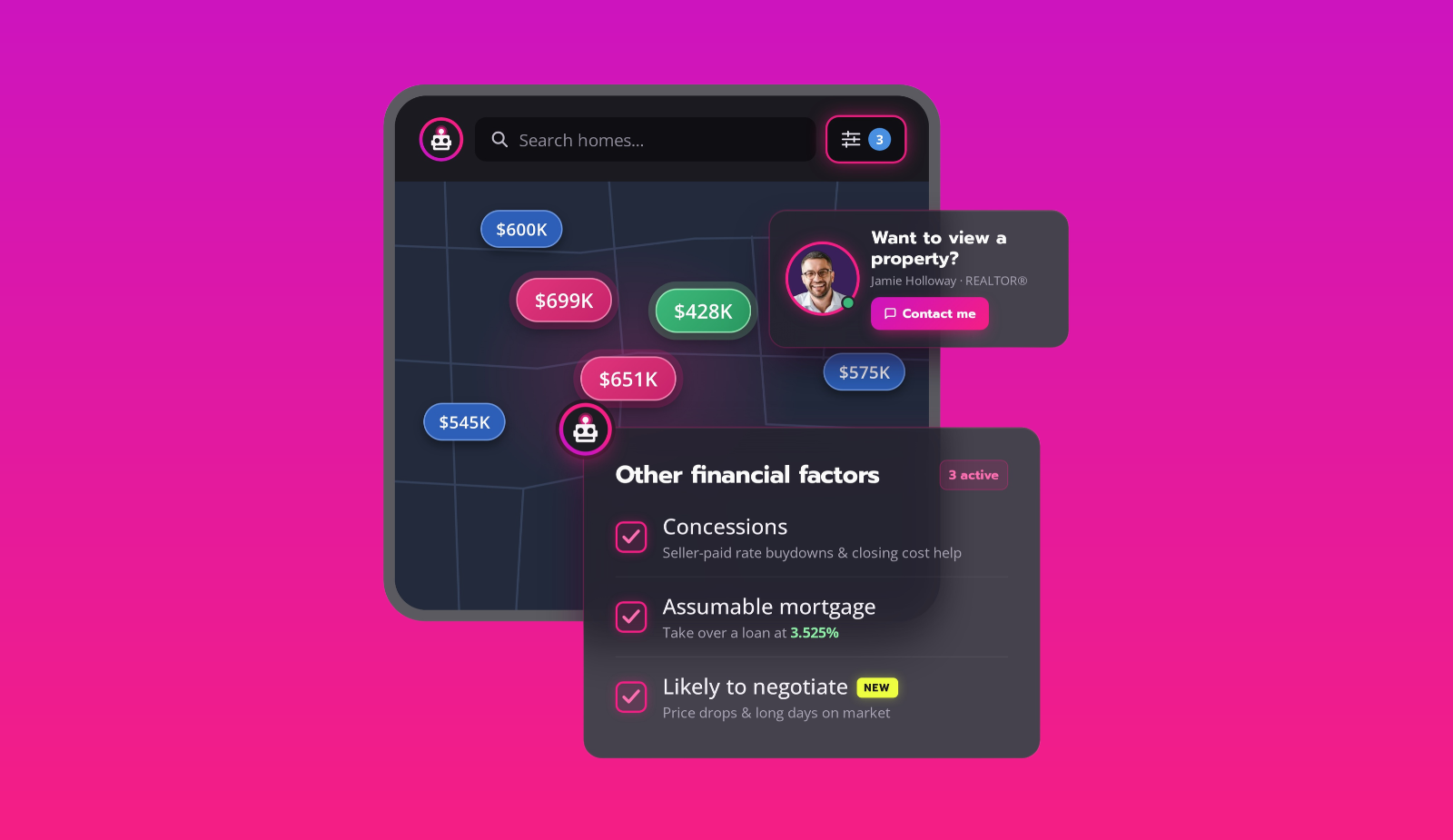
How to close in a high rate environment
- Lead with the monthly payment, not the rate. Find the number the buyer can live with, then back into the rate, price, and seller credit that hit it.
- Match each objection to the right financing play: a buydown, an ARM, a non-QM loan, an assumable mortgage, or a buy-before-you-sell plan.
- Use seller money on purpose. Size the concession to the play before the offer goes in, so the financing holds up at the closing table.
- Reach buyers before they go quiet. Homebot engagement data shows which clients are researching each strategy, so you call with the right play first.
Your buyer loves the house. The price works, the neighborhood works, and the kids already picked their rooms. Then they see the monthly payment and the deal goes quiet.
That quiet moment is happening on desks across the country, and the numbers explain why. The average 30-year fixed rate held at 7.40% in mid-October, and Fannie Mae now expects rates to average 7.5% through all of 2027, up from the 6.7% it projected a month earlier.
Closing in a high rate environment means structuring the loan around the buyer's budget, matching their objection to the right financing play, and using seller money strategically. The loan officers winning right now lead with strategy and talk about rate last.
This guide covers seven plays you can use today, each tied to something buyers are already saying to you, plus what to ask the seller for so the play holds up at the closing table.

Why a Better Rate Quote Won't Restart a Stalled Deal
When that buyer goes quiet, the first move for most loan officers is to send a sharper rate quote. It rarely gets the deal moving, because a rate answers the wrong question. The buyer looking at that monthly payment wants to know if this home fits their life and budget, and the rate on its own tells them nothing about either.
1. Waiting for lower rates costs buyers more
The silence often means the buyer is waiting: many are holding out for a drop that forecasters no longer expect, treating the high rate environment as temporary. With Fannie Mae projecting a flat 7.5% across 2027, waiting means paying more rent while home prices keep moving.
Your job is to give them a reality check on today's market and then show them what they can do inside it.
2. Buyers need an advisor more than a rate sheet
Buyers can find a rate on any website. In a high rate environment, they need someone who builds the payment around their budget, explains the trade-offs, and structures the deal so it closes.
That's the role every tip below helps you play, for buyers and for the real estate agents who refer them, and in a high rate environment it starts with the monthly payment the buyer can actually live with.
Tip 1: Start With the Buyer's Budget, Then Back Into the Rate
So when you call that buyer back, lead with their budget instead of a new quote. The first move when closing in a high rate environment is to set the payment before you talk about rate. Find the monthly number that fits the buyer's life, then work backward to the rate, price, and seller credit that hit it.
1. Anchor the payment to lifestyle and goals
Start with what this move means to the buyer: the commute, the extra bedroom, the school, the plan for the next five years. Then match a home and a monthly payment to that picture.
If the budget and the wish list don't line up, have that honest conversation early so no one loses a weekend to showings that were never going to work.
2. Size the seller credit to the rate the budget needs
Once you know the target payment, you know the rate that gets there and the credit it takes to buy it. Tell the buyer and their agent the exact number to ask for.
If the agent plans to ask for $10,000 and the math says $16,000 gets the buyer to their payment, say so before the offer goes in. A credit sized to the budget gives the deal its best chance to close.
Tip 2: Use a Mortgage Rate Buydown When the Payment Is Too High
The seller credit you sized in Tip 1 most often pays for a mortgage rate buydown. Buydowns are the most common way to close the payment gap in a high rate environment. It lowers the buyer's interest rate in exchange for an upfront payment, usually funded by the seller, builder, or lender, and there's more than one kind.
1. Compare a price reduction, a permanent buydown, and a temporary buydown
Each option moves the payment differently, so run all three for the same deal.
- Price reduction: At 7.4% on a 30-year loan, every $10,000 off the loan amount saves about $69 a month. It helps, but slowly.
- Permanent buydown: The buyer pays discount points, where one point equals 1% of the loan amount, for a lower rate for the life of the loan. How far each point moves the rate depends on the day's rate sheet.
- Temporary buydown: A 2-1 or 1-0 buydown lowers the rate for the first year or two, then it steps up to the note rate. Under Fannie Mae guidelines, the buyer still qualifies without counting the bought-down rate.
On a $450,000 loan at 7.4%, principal and interest run about $3,116 a month. Buy that rate down to 6.4% and the payment drops to about $2,815, roughly $300 a month for 30 years.
2. Know when a temporary buydown still makes sense
With few people expecting rates to fall soon, temporary buydowns have taken a back seat. They still win when a buyer has a clear ramp-up ahead.
- A parent heading back to work after a year at home
- A new job with a training period before full pay
- A second-home buyer who needs a year to get rental income going
A 2-1 buydown on that same $450,000 loan costs about $10,700 in subsidy. It gives the buyer a payment near $2,527 in year one and $2,815 in year two before settling at the full payment.
3. Show how a buydown raises purchasing power
A buydown changes more than the payment. It changes the price point the buyer can shop.
At a $3,000 principal and interest budget, a buyer can carry about a $433,000 loan at 7.4%. Bring the rate to 5.5% and the same payment carries about $528,000. That's a bigger home, a better neighborhood, or one more bedroom for the same monthly cost.
Purchasing power is the buydown story that wins in a high rate environment. It matters most near new construction, where builders are advertising aggressive rate buydowns. A resale seller who won't offer concessions is competing against homes that cost buyers far less each month.

4. Stack builder, seller, and lender credits
Credits from more than one source can work together. A builder might fund a permanent buydown while the lender adds a 1-0 temporary buydown on top, giving the buyer a lower long-term rate plus first-year breathing room.
Work the rate sheet too. If a small buyer contribution reaches the next pricing tier, show them the trade-off.
Tip 3: Match the Right Buyer to an Adjustable-Rate Mortgage in a High Rate Environment
Some deals have no seller or builder money to fund a buydown, or the buydown still leaves the payment too high. For those deals, an adjustable-rate mortgage can lower the starting payment, but it only fits certain buyers. Show the pros and the cons every time, even when the buyer brings it up first.
1. Know who an ARM fits
ARMs make sense for buyers with a clear plan for the years after the fixed period ends.
- Expected income jumps: A new physician or a salesperson with steady year-over-year growth
- Short hold periods: A buyer who plans to sell or move before the rate adjusts
- Planned paydown: A buyer who will put sale proceeds or a windfall toward the balance and recast
2. Know who should avoid one
Steer buyers away from an ARM when the fixed period ending would hurt them.
- Buyers on a fixed income or a tight budget
- Families planning to stay in the home for a long time
- Anyone using the lower start rate to stretch into a home they can't afford at the fully adjusted payment
3. Explain 5/6, 7/6, and 10/6 ARMs
In a 5/6, 7/6, or 10/6 ARM, the first number is how many years the rate stays fixed. The 6 means the rate adjusts every six months after that, tied to an index like SOFR.
Every ARM has three rate caps: an initial cap on the first change, a subsequent cap on each change after, and a lifetime cap. Walk through all three on every quote.
Shorter terms can carry lower rates but are harder to qualify for. On a 5-year ARM, Fannie Mae qualifies the buyer at the higher of the fully indexed rate or the note rate plus 2%. ARMs fixed for more than five years qualify at the note rate, which is why a 7/6 often hits the best balance.
Tip 4: Learn Non-QM Loans for Buyers Who Don't Fit the Box
Buydowns and ARMs only help a buyer who qualifies on paper, and some self-employed buyers and investors don't, even with steady income. In a high rate environment, every qualified buyer counts, and non-QM loans qualify these buyers through alternative documentation when tax returns and W-2s don't tell the whole story. They're no longer a niche. Non-QM loans made up 11.3% of mortgage lock volume in August, close to one in nine buyers.
1. Master bank statement loans for self-employed buyers
Bank statement loans use 12 or 24 months of deposits to calculate income. They help business owners whose tax returns show declining income after write-offs.
Learn what counts as a qualifying deposit and how to handle transfers between accounts. Those details decide whether the file holds up.
2. Use DSCR loans for investors
DSCR loans qualify an investment property on its rental income compared to the mortgage payment. Rents that cover the payment earn the best pricing, and some programs still work when rents fall short.
With longtime investors selling portfolios, DSCR loans give newer investors a path to buy.
3. Work down the ladder from conventional
A buyer who says "I need a DSCR loan" may not. Review their documents first, because standard financing almost always brings a better rate and terms.
Move to bank statement, then DSCR, then no-ratio options only when the file calls for it. Each step fits the risk the lender takes on.
4. Turn "no" into "not yet" with a plan
Some buyers aren't ready. Build them a plan with budget targets and touch points, and share it with their agent so you both stay in contact until they are.
Tip 5: Find Assumable Mortgages Where the Math Works
The plays so far all build a new loan at today's rates. An assumable mortgage skips that step by letting the buyer take over the seller's existing loan, rate and all, and when the remaining balance is large, it can save a buyer hundreds a month in a high rate environment.
1. Know which loans are assumable and how long they take
FHA, VA, and USDA loans are generally assumable. Conventional loans usually aren't, outside of situations like a divorce.
The buyer applies through the seller's servicer, not their own lender, and must be fully documented. Servicers aren't built for originations, so assumptions can take 30 to 90 days.
VA loans add a wrinkle. Anyone who meets lender criteria can assume one, but the seller's VA entitlement stays tied to the loan unless a qualifying veteran substitutes their own.
2. Run the gap financing before you get excited
The buyer has to cover the difference between the price and the loan balance, often with a second lien at a higher rate. That's where many assumptions fall apart.
Take a $600,000 home with 10% down at today's 7.4% rate: about $3,739 a month in principal and interest. If the seller has $400,000 left at 2.875%, and the buyer finances the remaining $140,000 at 9%, the combined payment lands near $2,997. That's about $740 a month in savings.
Flip it. If only $150,000 remains on the assumable loan, the buyer finances $390,000 at 9% and pays about $3,840, more than a new loan. A big balance makes the deal. A small one breaks it.
3. Build a blended rate calculator for your agents
Give your agent partners a simple spreadsheet: assumable balance, assumable rate, down payment, gap amount, and gap rate. They can test any listing in a minute.
Share it even when you can't originate the gap loan. Being the person who helps the deal close builds more referral business than holding back information.
4. Help buyers find assumable listings
Search your MLS for FHA, VA, and USDA financing. Homebot's Home Search adds an assumable filter buyers can use themselves, and you see when they do.
For more on structuring these deals, see how assumable mortgages benefit loan officers and their clients.

Tip 6: Help Move-Up Buyers Buy Before They Sell
Many of those low-rate loans belong to homeowners already in your database. In a high rate environment, move-up buyers sitting on low rates and big equity often won't move until the perfect home appears. A buy-before-you-sell plan lets them act the moment it does. Homeowners hold $11.7 trillion in tappable equity, so the opportunity is large.
1. Open a HELOC before the home is listed
A HELOC is often the lowest-cost way to access equity for a down payment. The home can't be listed when the line is opened, so this play works for planners.
Talk to your past clients about it before they start shopping. Have them pre-approved too, so they aren't calling you from a showing.
2. Use a bridge loan once the home is on the market
Bridge loans run from about four to 12 months and pull equity out of the current home for the down payment. The buyer typically has to qualify carrying both homes.
Pairing a bridge with a contract offer on the current home can help exclude that payment on conventional and jumbo loans, so the buyer can purchase first and list on their own timeline.
3. Compare bundled buy-before-you-sell programs
Bundled programs handle equity access and sometimes pay cash for the new home. They cost more but remove the stress of carrying two mortgages.
Lay out every option from lowest to highest cost so the buyer chooses with clear eyes.
4. Keep the low-rate home as a rental
For buyers with a low rate they hate to give up, converting the home to a rental can make sense. Run the cash flow carefully and connect them with property managers who can help.
5. Recast after the sale
Once the old home sells, the buyer can put the proceeds toward the new loan and recast. The rate and term stay the same, the balance drops, and so does the payment.
This is especially valuable when the buyer locked in a seller-paid permanent buydown they want to keep.
Tip 7: Ask Sellers for Concessions That Fit the Play
Almost every play above depends on seller money, so the offer is where you set it up. Seller concessions are common in a high rate environment because buyers have more room to ask for help, and each play needs a different ask. 44.7% of August home sales included seller concessions, according to Redfin.
1. Buydowns: ask for seller credits
Request a credit sized to the rate the buyer's budget needs. In a high rate environment, that number is often bigger than agents expect.
2. ARMs: ask for closing cost coverage
If a buydown isn't part of the plan, closing cost help protects the buyer's cash reserves for future rate changes.
3. Non-QM: ask up to the contribution limit
Non-QM rates run higher, so ask for the most the program allows to buy the rate down. On conventional loans, Fannie Mae caps interested party contributions at 3%, 6%, or 9% depending on the down payment, and 2% for investment properties.
4. Assumables: ask for time
Write enough time into the contract for the servicer, and have a list of lenders who offer gap financing ready.
5. Stalled listings: help the listing agent
Offer listing agents a flyer showing what a 1-0 or permanent buydown does to a buyer's payment. Even if the buyer uses another lender, you've earned the agent's trust.
How to Spot Which Clients Need a High Rate Environment Play Before They Call
Every play in this guide works best when you raise it before the buyer sees a payment they can't make and goes quiet. Engagement data tells you which strategy a client is already researching, so you can start that conversation first.
1. Watch buyer search and calculator activity
Buyers who filter for seller concessions, save assumable listings, or run buydown calculators are telling you which play they need. With Homebot's private home search, that activity shows up in your account, and their data is never sold to other lenders.
2. Spot move-up sellers early
When past clients start browsing listings or checking their equity, they may be getting ready to move. That's the moment for the buy-before-you-sell conversation.
3. Let HomebotAI tell you who to call
HomebotAI surfaces which clients to reach out to, gives you talking points based on their situation, and drafts the email. Every call has a reason behind it.
Conclusion: Start Three Conversations This Week
The buyer who loved the house and went quiet at the monthly payment is still a deal you can close. Closing in a high rate environment rewards loan officers who know their numbers and bring options before buyers ask, and the seven plays here give you a response to every common objection.
Pick three actions and do them in the next 48 hours:
- Call five buyers who paused this year and ask what they're waiting for
- Call one listing agent with a stalled listing and offer a buydown flyer
- Search your market for assumable listings and share the best ones with your database
Homebot helps you find the clients who need these plays and start the conversation at the right time.
- Private home search with filters for assumables and seller concessions
- Engagement alerts when buyers and past clients research their next move
- HomebotAI that tells you who to call and what to say
See how Homebot helps loan officers turn buyer signals into closings. Book a demo to see it with your own database.

Closing in a high rate environment, answered
A high rate environment means mortgage rates are high enough to push monthly payments above many buyers' budgets. Buyers can still purchase by using buydowns, the right loan type, and seller concessions to bring the payment back in range.
A permanent buydown lowers the rate for the life of the loan, which suits most buyers who plan to stay. A temporary buydown fits buyers with a clear income increase coming in the next year or two.
One discount point costs 1% of the loan amount. How much each point lowers the rate depends on the lender's pricing that day, so ask for a side-by-side quote.
Self-employed buyers, investors, and borrowers with nontraditional income often qualify through bank statements, rental income, or assets. Rates run higher than conventional loans, so review conventional options first.
Yes, a non-veteran can assume a VA loan if they meet the servicer's requirements. The seller's VA entitlement stays tied to the loan unless the buyer is a veteran who substitutes their own.
In a high rate environment, timing matters. Homebot shows you which buyers and past clients are researching buydowns, assumables, and equity. HomebotAI then tells you who to call and gives you talking points so you reach them first.