Insurance Agents
The Independent Insurance Agent's Guide: How to Get Insurance Referrals from Real Estate Agents

The real estate agent down the street closes 40 buyers a year. Every single one of them needs homeowners insurance before they can close. That's 40 warm, motivated, deadline-driven referrals. Right now, most of them are going to someone else.
If you closed 25 new clients last year but less than 10 came from real estate agent referrals, you already know the opportunity. Figuring out how to get insurance referrals from real estate agents is one of the most common questions among independent P&C agents; and the answer comes down to systems, not access.
The problem isn't that buyers don't need coverage. Every buyer needs a policy. The problem is that most agents don't have a reliable system for building and keeping the partnerships that generate that business.
Referrals convert at 4x the rate of other lead sources for insurance agencies. Referred clients stay longer and spend more. And unlike paid leads, good realtor partnerships compound. One relationship that sends you three buyers a month is worth more than almost any other prospecting activity you could run. Real estate agents are widely considered the best referral partners for insurance agents — every transaction they close is a policy that needs to be written.
This guide gives you the exact system: how to find the right agents, what to say, how to make the first transaction count, and how to build visibility so those partnerships don't quietly die between deals.
Why Most Insurance Agents Never Get Enough Referrals from Real Estate Agents
The opportunity is obvious. Every insurance agent knows it. But most never build a pipeline from it. Most real estate referral training for insurance agents focuses on the pitch — but the pitch is rarely the problem. Here's what's actually getting in the way:
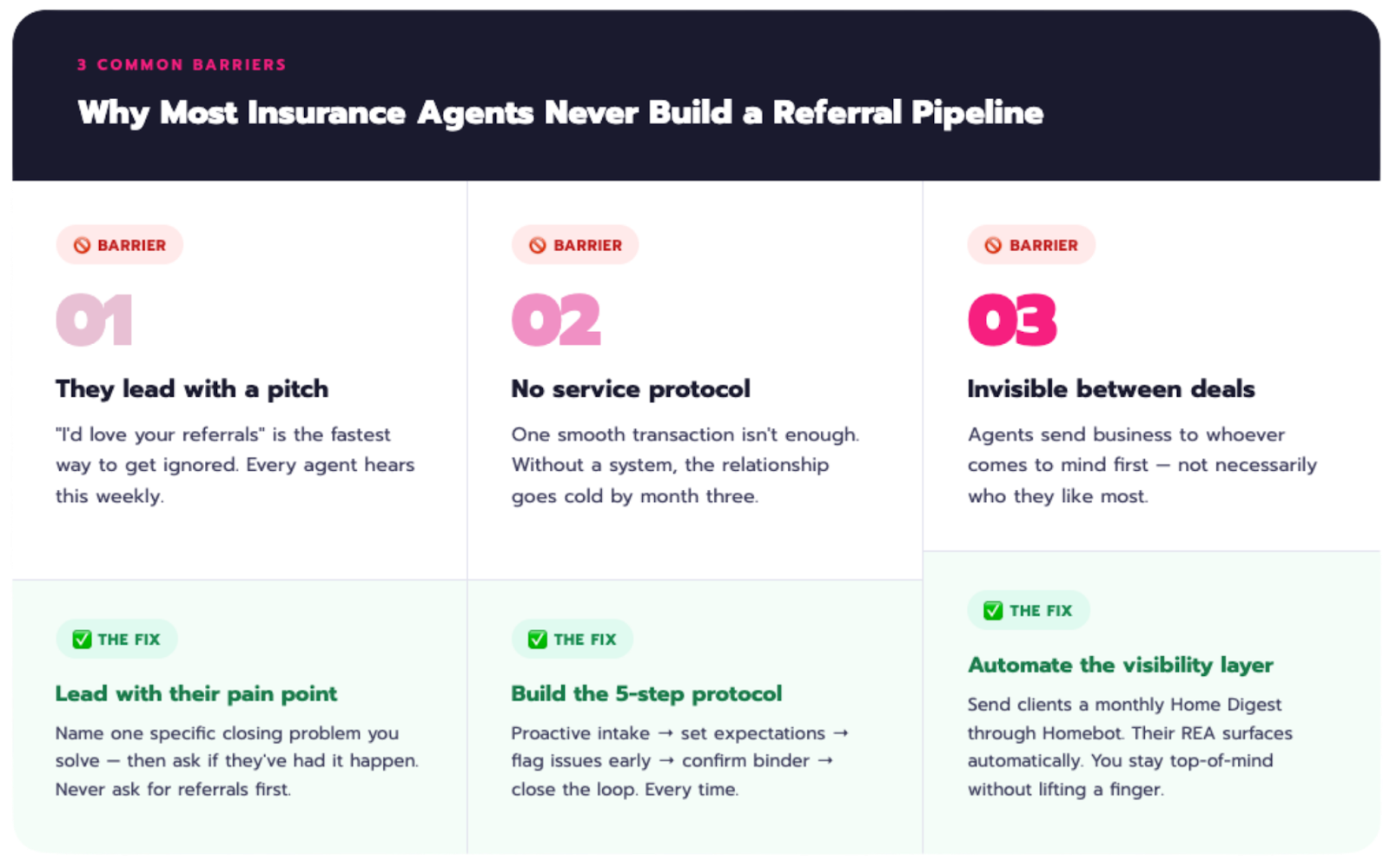
Barrier 1: They lead with a pitch
Walking into a brokerage open and saying "I'd love your referrals" is the fastest way to get ignored. Real estate agents hear that pitch from lenders, title reps, home warranty companies, and other insurance agent networking hopefuls every week. A generic ask produces a generic result.
Barrier 2: They have no service protocol
An agent refers a buyer. You write the policy. The deal closes. Three months later, the relationship is cold because there was no system to keep it warm. The agent sends their next buyer to someone else. Not because they forgot you, but because there was no reason to think of you.
Barrier 3: They're invisible between deals
Most agents only hear from you when a deal is in motion. That means every new referral starts cold. How to network as an insurance agent isn't about showing up more often — it's about staying visible to the right people when nothing is happening. The agents who consistently send business aren't necessarily better at insurance. They're just the ones who stayed visible.
What a Real Estate Agent Partnership Is Actually Worth
Before building the system, let's get clear on the math. Here's what three productive realtor partnerships can realistically produce:
- An active agent closes 25 buyers per year. Three partners = 75 potential referrals.
- Not every referral converts. Assume 60%, which is conservative for warm referrals. That's 45 new clients.
- Average homeowners premium: $1,400. Year 1 gross from those 45 clients: $63,000.
- At an 80% retention rate over 5 years, those 45 clients are worth roughly $252,000 in cumulative premium.
- Cost to build those partnerships: your time. Cost per equivalent paid lead at $2,750 each: $123,750.
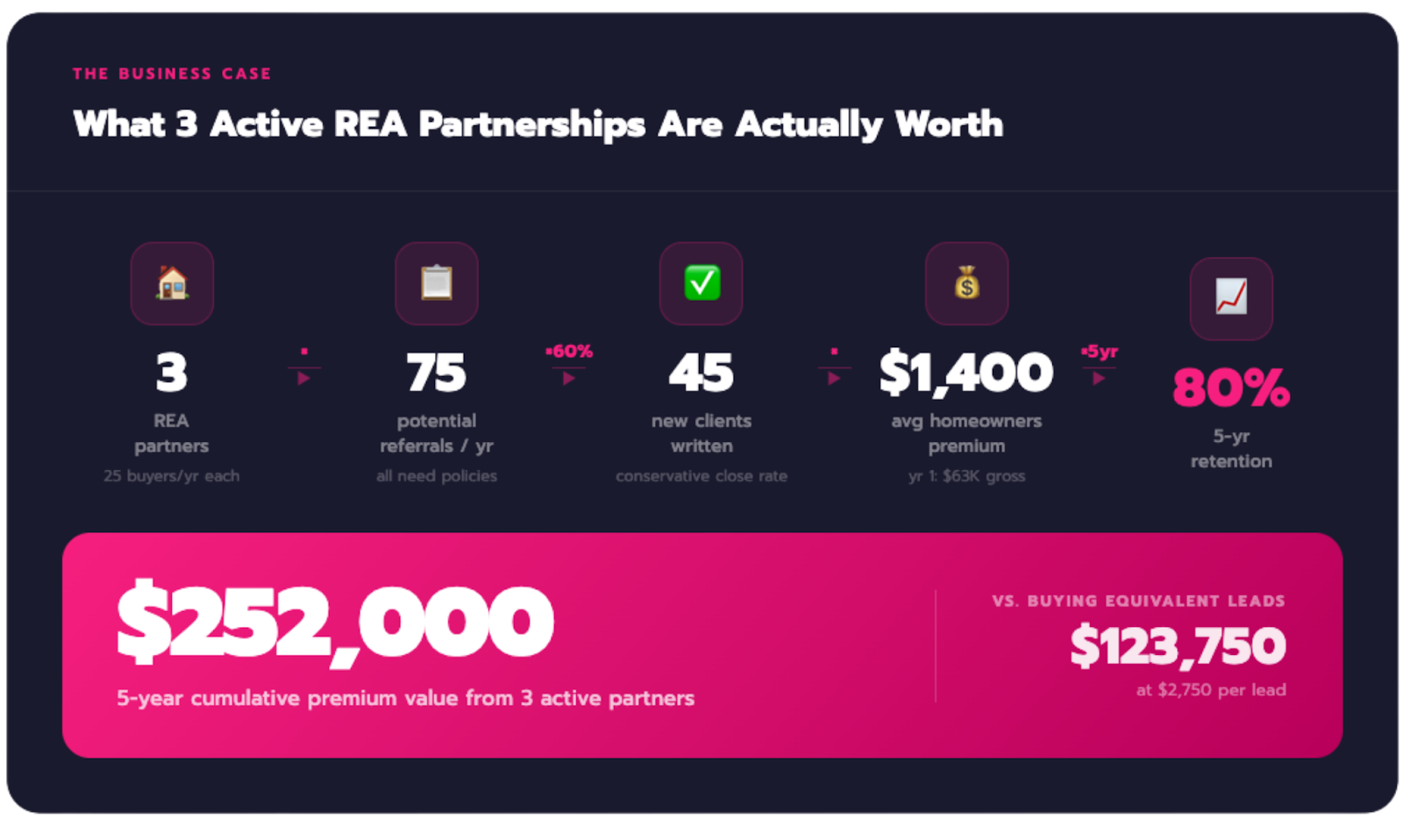
That means a 5-year premium value from 3 active realtor partners could be ~$252K (at avg $1,400 premium, 80% retention). For independent agents looking to grow without buying leads, real estate agents represent the best referral partners available.
The math gets better when you account for the referral multiplier. Referred clients refer others at a higher rate, and REA-referred clients often come in with multiple properties (rental properties, second homes) that need coverage too.
The 5 Step Playbook: How to Actually Get Insurance Referrals From Real Estate Agents
Knowing the opportunity exists doesn't close the gap. Most agents who've tried to build realtor referral partnerships ran the same play: showed up, introduced themselves, handed over a business card, and waited. Nothing happened. They assumed the channel doesn't work.
It works. The execution just needs to be more deliberate. Here's the system, start to finish.
Step 1: Find the Right Real Estate Agents (Not Just Any)
The biggest mistake is reaching out to every agent in your market. A part-time agent doing six deals a year has no referral volume. You need active agents, and you need to know how to tell the difference before you spend time on them.
Who you're looking for:
- Agents or small teams closing 20+ transactions per year. Volume is the priority.
- Buyer-focused agents, not listing-only agents who rarely see first-time buyers
- Agents with a reputation for staying in close contact throughout the transaction
- Teams with dedicated buyer agents. A 50-deal team with two buyer's agents is a consistent pipeline on its own.
Red flags to avoid:
- Sporadic closers who do 3 deals one quarter and disappear. No referral rhythm.
- Agents who don't return calls quickly (if they're slow with you, they're slow with clients)
- High turnover brokerages. Your contact list will go stale fast.
Where to find potential real estate agent partners:
- MLS transaction data. Public record shows exactly who's closing and how often.
- Homebot's Partner Intel: search high-performing agents in your area by volume and partnership status.
- Your lender contacts. Every loan officer has a list of the REAs they work with regularly
- Broker opens and REALTOR association events. Attend to observe, not to pitch.

Step 2: The Approach That Actually Gets a Response
You've identified three or four agents worth targeting. How you say it matters as much as what you say. Knowing how to network as an insurance agent in the real estate world means leading with their problems, not your pitch.
When an agent gets an outreach from an insurance professional, they're subconsciously running three quick checks:
- "What do they want from me?" (Your answer: nothing yet. I want to make your transactions smoother.)
- "Can this person actually help my clients?" (Your answer: yes, and here's one specific way)
- "Is this going to be more work for me?" (Your answer: the opposite)
Your first message needs to answer all three without explicitly saying so. Here's how:
What to Say and What to Never Say:
Step 3: Make the First Transaction the One They Remember
Every agent you approach has had a bad experience with an insurance contact before. A slow quote. A missing binder. A buyer who called them panicking because no one told them about the four-point inspection requirement until day 30.
Your job on the first transaction isn't just to do good work. It's to make the contrast obvious.
The service protocol that builds referral relationships:
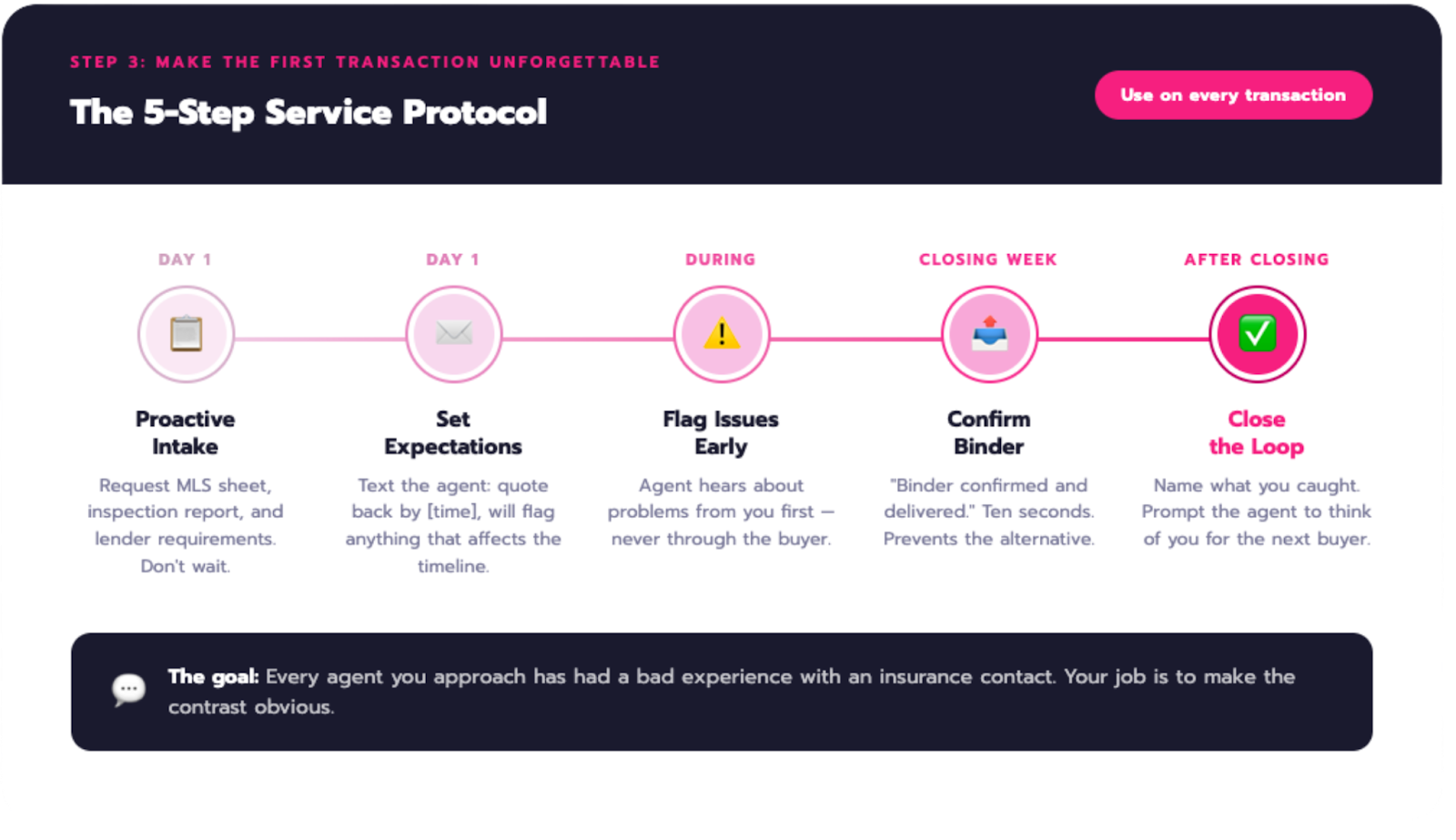
- Day 1 Proactive intake: When the buyer is referred, immediately request the MLS sheet, inspection report, and lender requirements. Don't wait to be asked. Anticipating what you need prevents surprises.
- Day 1 Set expectations: Send the agent a quick note: "Got the referral from [Buyer Name]. I'll have a quote back to them by [time] today and will keep you posted if anything comes up that could affect the timeline."
- During underwriting: Flag any issues immediately: hard-to-insure conditions, coverage gaps, premium surprises. Don't let anything reach the agent through the buyer first.
- Closing week: Confirm binder delivery with the title company and the agent directly. A quick "binder is confirmed and delivered" text takes 10 seconds and saves everyone from the alternative.
- After closing: Close the loop. Send the agent a brief note: "[Buyer Name] is all set. We also caught [specific issue, e.g., 'a coverage gap on their detached garage']). Nothing that held up closing. Good for them to know."
Step 4: Build the System That Keeps Partnerships Alive
One smooth transaction doesn't build a referral pipeline. What kills most insurance agent / realtor partnerships isn't bad service. It's invisibility between deals. The agent who consistently sends you business isn't necessarily the one who likes you most. It's the one whose name pops into their head when a buyer needs a recommendation.
The partnership maintenance cadence:
- Monthly touchpoint: A 10-minute check-in (by phone or text) with each active partner. Not to ask for business. To share what's coming in the market (coastal rate changes, new underwriting requirements, inspection trends) that's actually useful to them.
- Quarterly pipeline review: Bring data: "We helped four of your buyers close last quarter, total premium was $X, no delays." Agents don't hear this from anyone. It will stand out.
- CRM tracking: Log every referral in, every close, every outcome. You can't have the quarterly conversation without this data, and you can't scale without knowing which partners are actually producing.
- The network give-back: Introduce your REA partners to trusted lenders, contractors, and CPAs. The agents who get the most consistent referrals from insurance contacts are usually the ones who send referrals back out too.
This is the foundation of a sustainable independent insurance agents network — built on consistent, mutual value rather than one-time introductions.
Step 5: Automate the Visibility Layer
Manual follow-up works until you get busy. Then it stops. Not because you stopped caring, because you ran out of bandwidth. The fix isn't more discipline. It's removing yourself from the equation entirely for the touchpoints that don't need to be personal.
Here's how to set it up with Homebot Network.
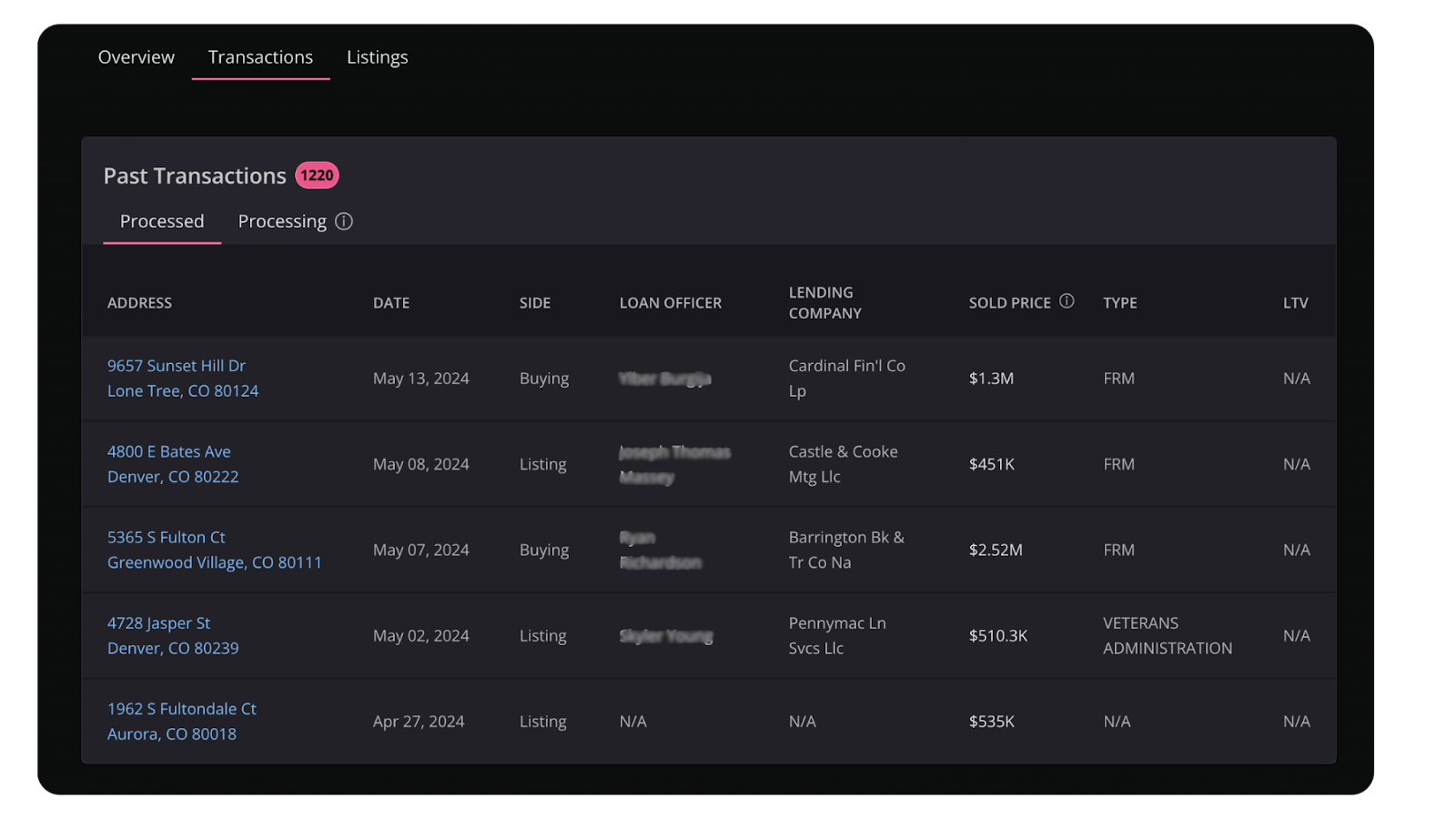
- Find the right agents first. Use Partner Intel to search agents in your area by transaction volume. Filter by who's active, who's closing consistently, and who doesn't already have a dedicated insurance contact. You're not cold-calling a list. You're targeting agents who actually need what you offer.
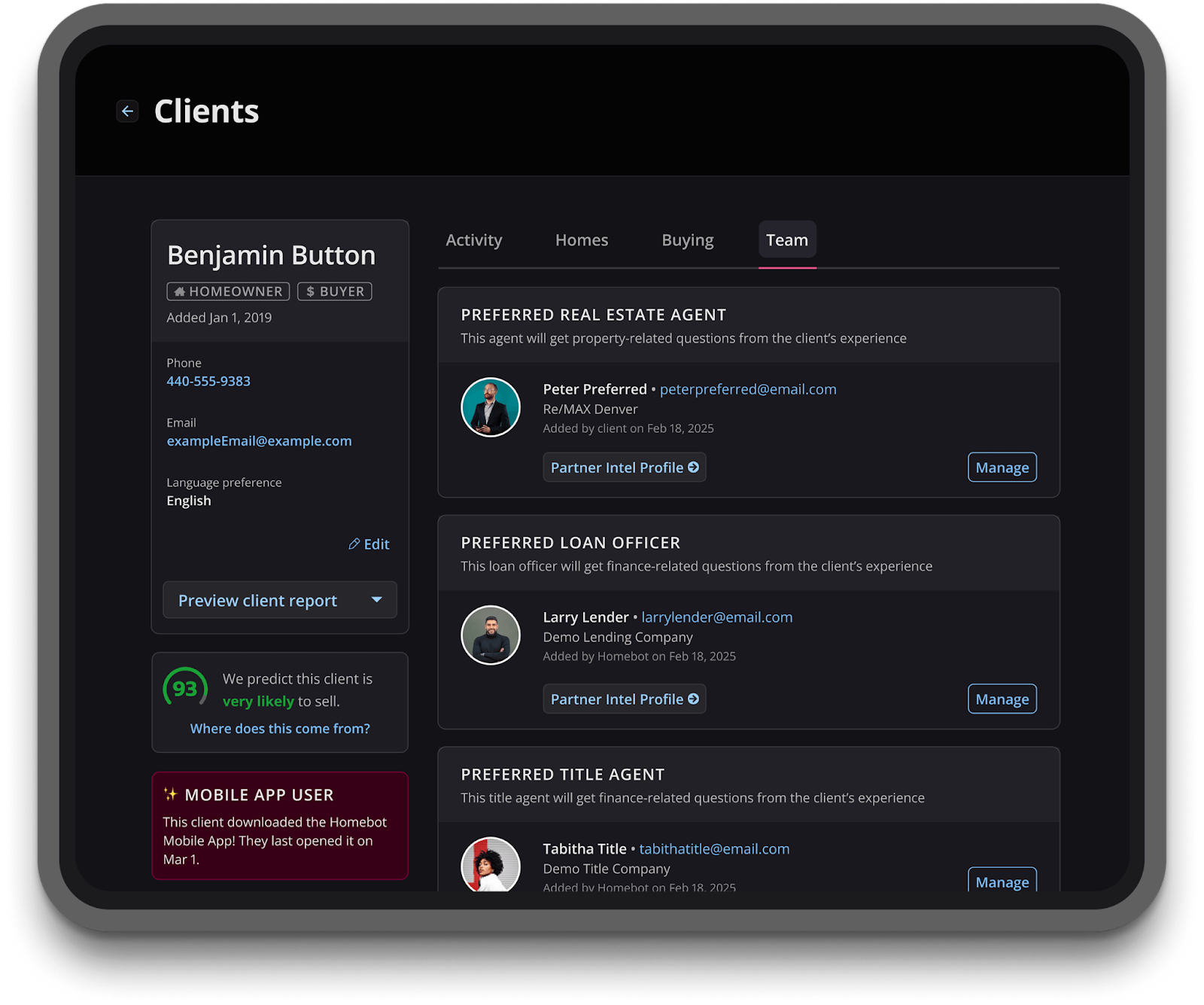
- Send clients automated monthly home insights:. Once you've worked with an REA partner, load your shared clients into Homebot. Every month, those clients get a Homeowner’s Digest email from you with their home value, equity position, and financial insights. That digest automatically surfaces their full professional team: you, the lender who closed their loan, and the real estate agent who helped them buy. 76% open rate. You don't schedule it. You don't write it. It just goes out.
- Let your agent see you working. Your REA partner sees their own name showing up in your clients' monthly digests. You're the one delivering the value. They get visibility through you, not the other way around. That consistency is what earns default referrals. Not because you followed up. Because you were already adding value before the ask.
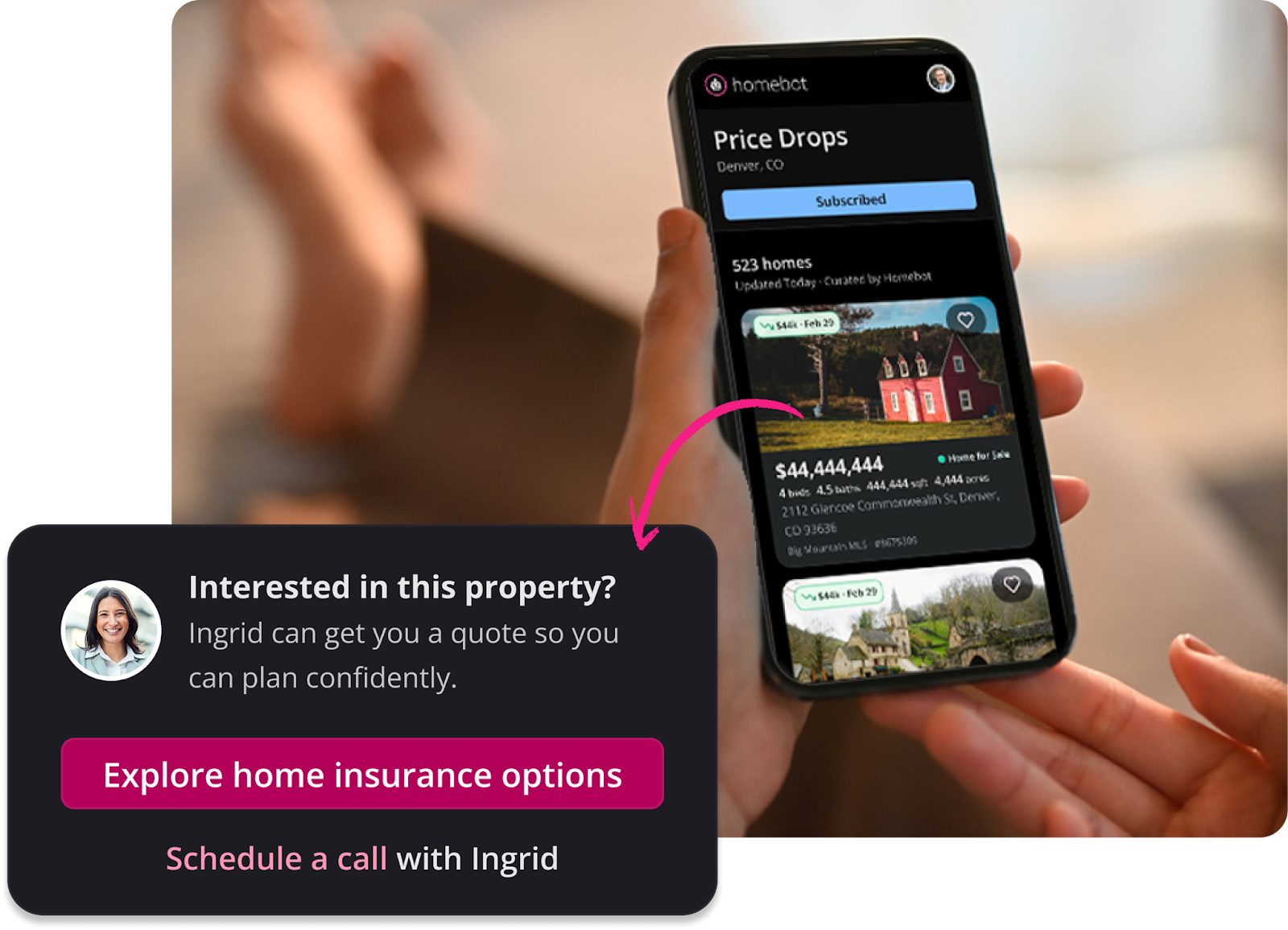
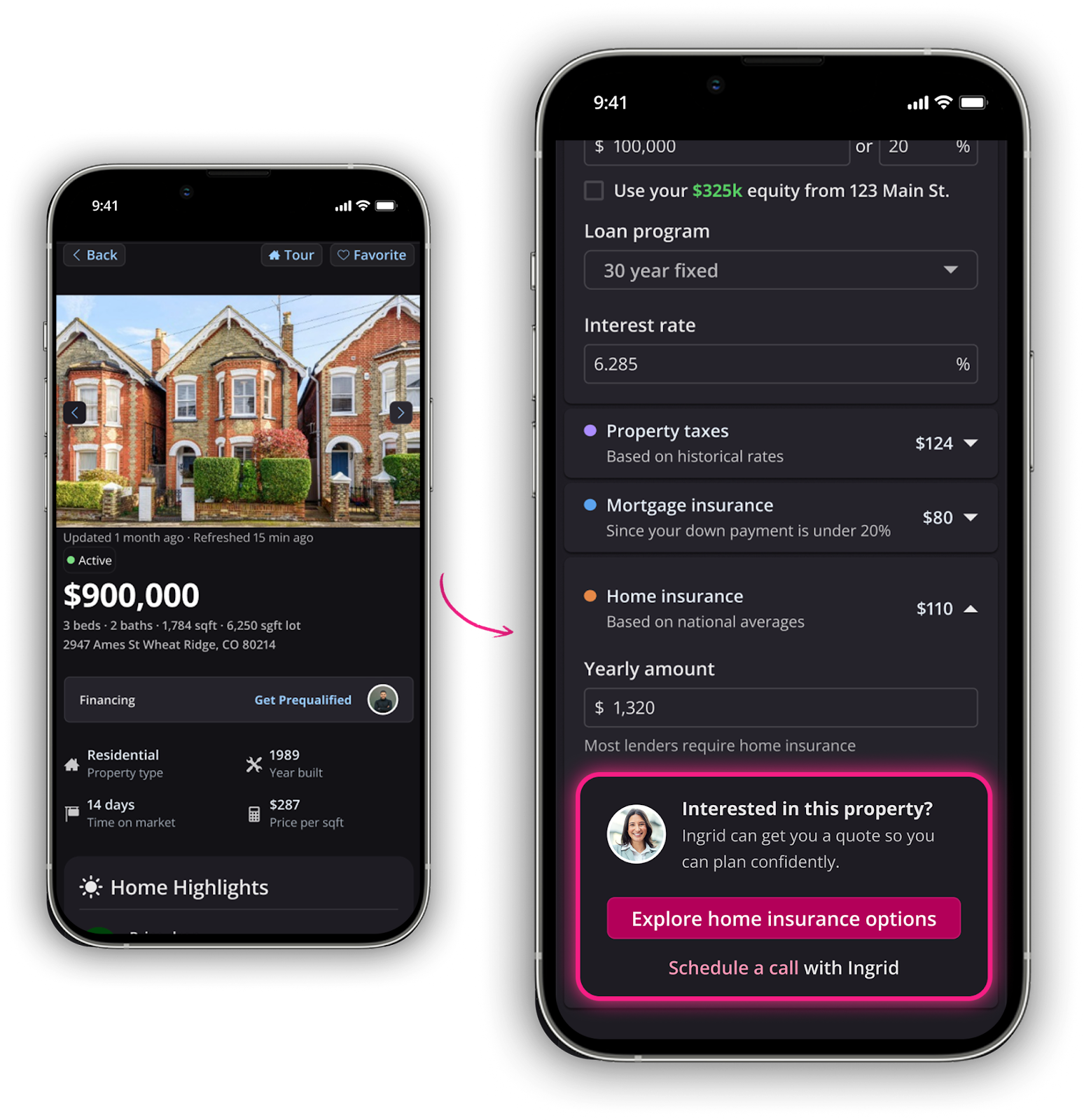
- Capture inbound questions before they go cold. When a homeowner asks an insurance question through their digest or home search, you get notified directly. It's a natural opening. They reached out first, and you have context on exactly what they asked.
- Set X-date reminders on existing clients. Upload policy renewal dates and get 60-day alerts so you never miss a re-quote window. Existing clients are the easiest revenue you have. Don't let renewals sneak up on you.
The agents who stick with you long-term aren't just sending referrals. They're seeing you show up for their clients month after month. Homebot Network is how that happens without it living on your to-do list. This is exactly the kind of independent insurance agents network infrastructure that separates producers who build real referral pipelines from those who stay stuck in one-off outreach.
Your 90-Day Plan for Getting Insurance Referrals from Real Estate Agents
Here's how to take everything above and actually execute it. Think of this as your real estate referral training for insurance agents — a repeatable system you run once, then continue to refine.
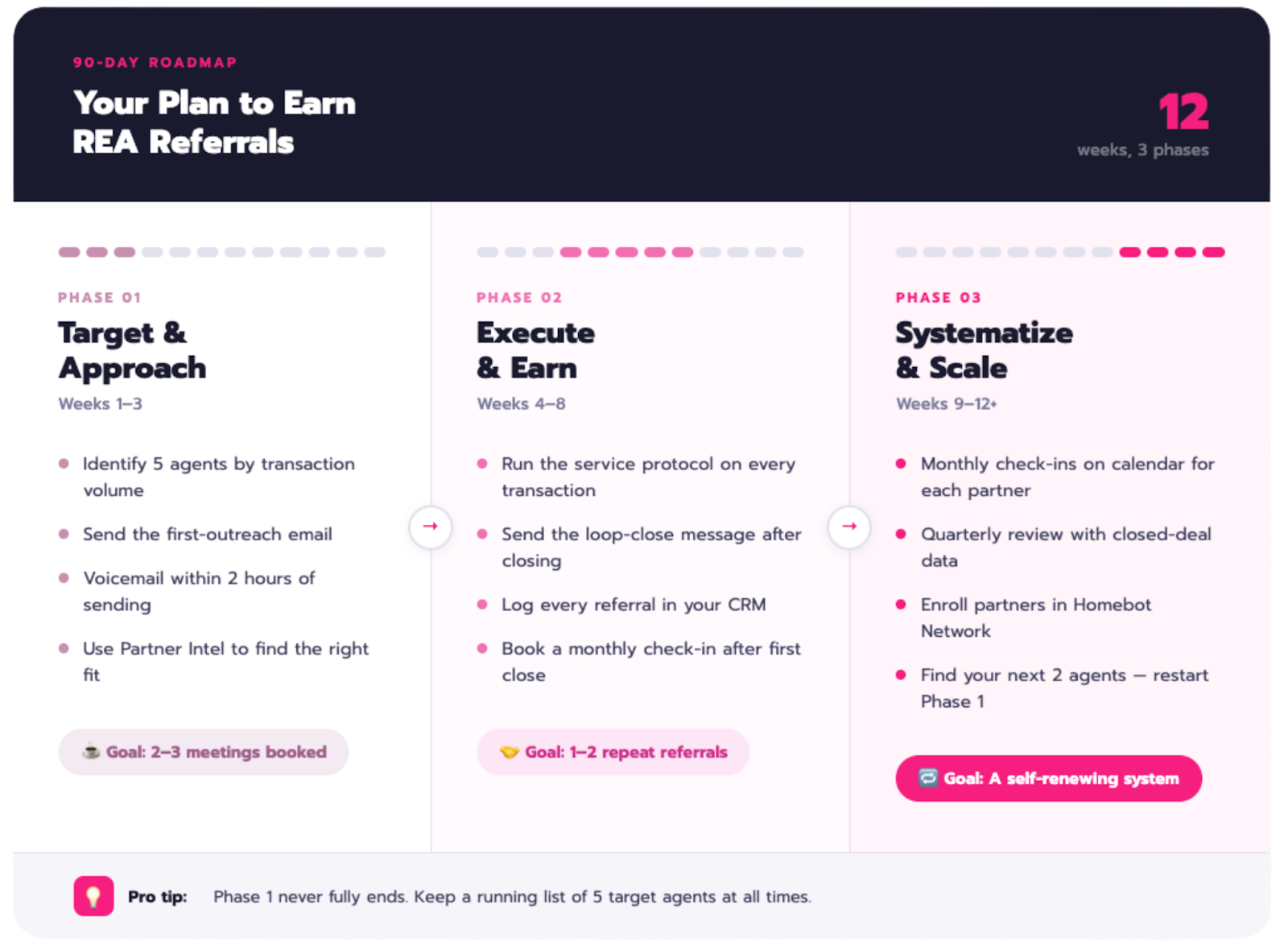
Phase 1: Target and Approach (Weeks 1–3)
- Identify 5 target agents using transaction data or Partner Intel. Volume first.
- Send the first-outreach email to each one (use the script above, customize specifics)
- Leave the voicemail within 2 hours of sending the email
- Goal: book 2 to 3 coffee meetings
Phase 2: Execute and Earn (Weeks 4–8)
- Deliver the service protocol on every referred transaction: proactive intake, then the loop-close message
- After your first smooth close, ask for a 10-minute monthly check-in with that agent
- Log every referral in your CRM with agent name, buyer name, outcome, and premium
- Goal: 1 to 2 repeat referrals from a partner you've already worked with
Phase 3: Systematize and Scale (Weeks 9–12+)
- Set monthly check-ins with your two to three most active partners on your calendar
- Run a quarterly review: show your partners what you've closed together
- Enroll active partners in Homebot Network to automate the visibility layer
- Identify your next two target agents and restart Phase 1
Tracking Your Referral Programs Success
What good looks like at 90 days
- 1 to 2 active partners producing consistent referrals
- A written service protocol you follow on every referred transaction
- A CRM record of every referral with outcome and premium data
- Quarterly touchpoint cadence on calendar with each active partner
Conclusion: Start Getting Insurance Referrals from Real Estate Agents Today
Two or three productive real estate agent partnerships can change your book of business. The right agents, a service protocol they can count on, and a visibility system that runs in the background whether you're busy or not.
Homebot keeps your name in front of shared clients every month automatically. Your realtor partner sees you promoting them without asking for anything in return. When a renewal comes up or a client has a question, you're already there. The agents who are sending referrals to insurance agents aren't sending them to the one with the best pitch. They're sending them to the person who has actively contributed to the relationship over the past six months.
If you're serious about learning how to get insurance referrals from real estate agents consistently — not just occasionally — the answer is the same every time: show up early, serve well, stay visible. Homebot Network automates the visibility. The rest is execution.
Ready to grow your referral network? Request a demo to see how it works