Monthly Mortgage Digest
Rates Are Near 7% and the Fed Just Hiked: What This Fall Means for Your Pipeline
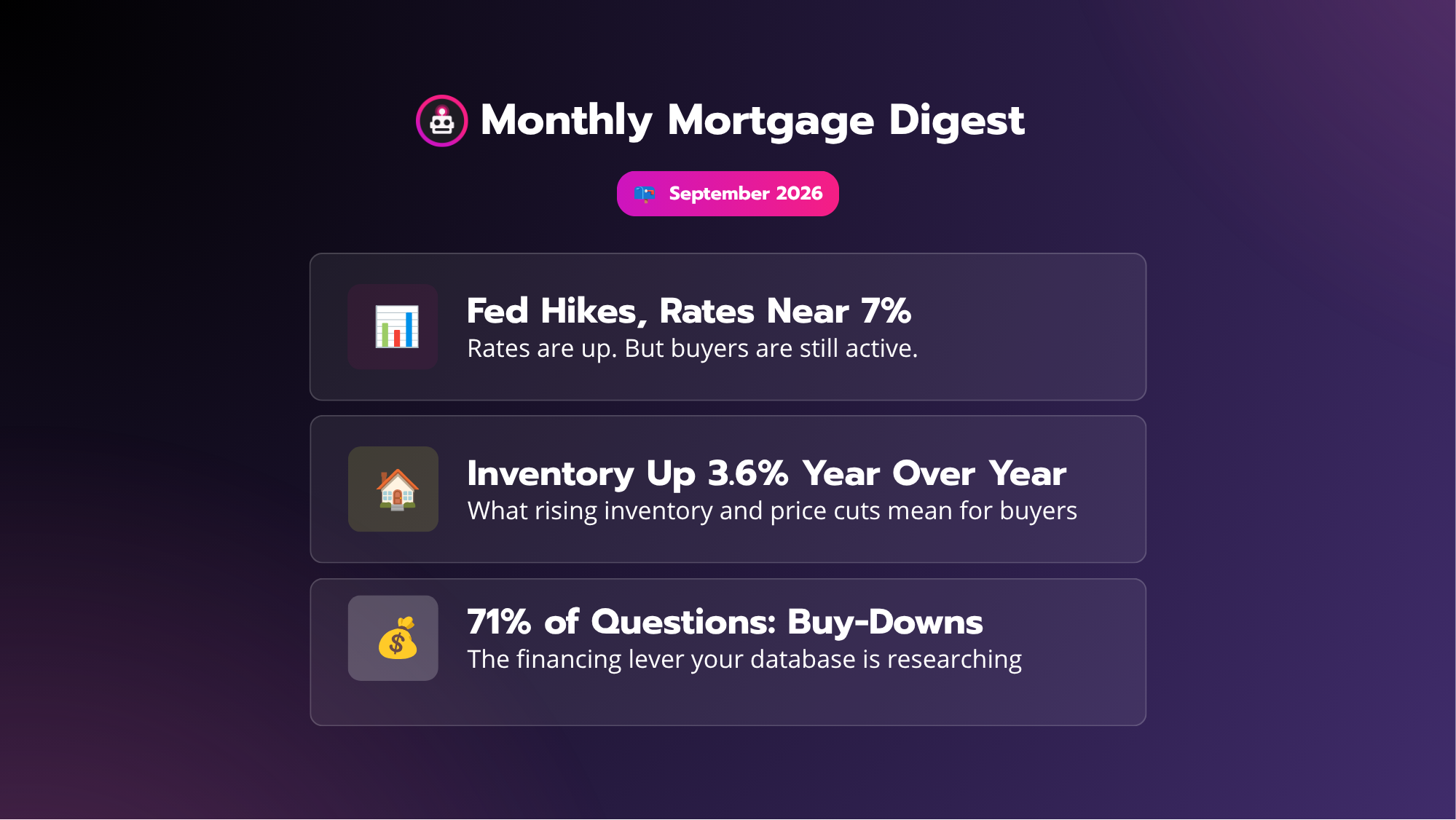
The Monthly Mortgage Digest
Rate trends, homeowner behavior, and what it means for your pipeline.
Rates are up to 6.95%, and the Fed just raised its benchmark rate for the first time since 2023. The rate cut buyers spent all year waiting for isn't coming.
The good news is, clients aren't sitting on their hands. There are 1.14 million homes for sale, and CMA requests jumped 29% in August. But they do want to talk affordability... so, have you been jumping in to have that conversation?
Below, we're covering what the Fed hike means for your clients, why list prices have fallen for 10 straight months, and how climbing insurance costs are cutting into what buyers can actually afford (yes insurance agents, we're talking to you!). Read on.
What's Happening in the Market
1. Rates Climbed to 6.95% - The Summer Dip Didn't Last
Freddie Mac put the 30-year fixed at 6.95% on September 17, up from 6.76% the week before. Rates dipped to 6.65% in late August, but that didn't last, and they have climbed back as Treasury yields rise. That puts today's rate about three-quarters of a point above where it sat six months ago and 69 basis points above a year ago. Buyers waiting to move until rates drop are realizing that might be a losing game.
For Lenders
- Run the buydown math for anyone on the fence. On a $400,000 loan, a 2-1 buydown lowers the payment now without your borrower waiting on something that may not happen.
- Update the pre-approvals you wrote this summer. The payment numbers from August are already out of date, and buyers need current figures to make a competitive offer.
For Real Estate Agents
- Check in with buyers who paused to wait for lower rates. Rates are going up, and the homes they wanted are still on the market today.
- Bring payment into the pricing conversation. With more listings and softer prices, a good offer now can beat a lower rate that may never come.
2. The Fed Raised Rates for the First Time Since 2023
On September 16, the Fed raised its target range to 3.75% to 4.00%, its first hike since July 2023, and the vote was unanimous. Three members had already voted to raise rates in July, and the data since then strengthened their case. The economy added 162,000 jobs in August, unemployment is 4.1%, and August inflation came in at 3.4%, with core prices a touch hotter than expected. Chair Kevin Warsh said inflation "is too high and has been for too long."
The Fed also signaled it may raise again. Officials' median projection shows one more quarter-point hike before the end of the year, and the 30-year fixed hit 6.95% the day after the decision. If your clients are waiting on a rate cut before they move, the Fed's own projection shows another hike this year instead. Show them what their payment looks like at today's rate and what waiting has cost buyers this year.
For Lenders
- Do not build your pipeline around a rate cut that may not come. Lean on the tools your borrower controls now, like buydowns, lender credits, and lock-and-shop programs.
- If you haven't sent a short note about the hike yet, send one. Your borrowers saw the headline, so tell them what it means for their rate before they call you worried.
For Real Estate Agents
- Talk to any buyer who is still waiting for rates to drop. The Fed just raised rates and signaled one more hike this year, so waiting is likely to cost them more.
- Get every serious buyer in front of a lender for real payment numbers, so they make the timing decision with today's math.
3. Refinance Volume Fell Again - A Sixth Straight Monthly Drop
Mortgage applications fell 3.2% in August, the sixth month in a row they have dropped, and they are running 9.1% below last year. Refinance applications were down 3.5% for the month and about 17% below a year ago. The average refinance loan size fell to around $282,000, the smallest since June 2025, which tells you the bigger-balance borrowers are staying put. With rates climbing again, none of that is about to turn around.
Refinances still made up about 42% of applications, so the volume is not zero. It is just narrow. This is a list you work by name, not a campaign you blast.
For Lenders
- Pull the borrowers you closed at 7% or higher in the last two years for rate-and-term reviews, and your equity-rich owners for cash-out or debt consolidation.
- Skip the mass email. With volume this thin, lead each call with the specific reason that borrower would move today. Homebot surfaces those borrowers from your own database, ranked by equity, rate, and activity like refi calculator use.

4. There Are 1.14 Million Homes for Sale - Buyers Have Choices Again
Active listings hit 1,140,035 in the latest report, up 3.6% from a year ago. That is still about 11% below where inventory sat before the pandemic, so this is not a glut, but buyers have more to look at than they have in a while. New listings came in at 401,760, down for the season but flat with last year, and 20.4% of listings had a price cut, the highest share for any month in 2026 so far.
More homes and more price cuts mean more room to negotiate. For buyers who have been frustrated, this is the opening they were waiting for, even with rates up.
For Lenders
- Get your hesitant buyers fully pre-approved now, so they can move when the right home shows up.
- Point buyers toward seller concessions. With one in five sellers cutting price, a seller-paid buydown can offset the higher rate directly.
For Real Estate Agents
- Use the price cuts and days-on-market in your area to back up stronger offers and concession requests.
- Set listing prices realistically from day one. There is more competition now, and chasing the market down costs sellers more than pricing right up front.
5. List Prices Have Slipped for 10 Months Straight - But More Slowly
The national median list price was $424,500, down 1.3% from a year ago, the 10th month in a row of annual declines. The drop was about half the size of the month before, so prices are easing rather than falling off a cliff. Where you work matters more than the national number: inventory is rebuilding fastest in the Midwest and Northeast, prices are holding up best in the Midwest, and the South and West are seeing the softest pricing.
Sellers are being patient rather than panicking. Delistings ran 12.6% below last year, and pending sales posted their first annual decline since November. Owners are cutting price to sell, not pulling their homes off the market.
For Lenders
- Know which way your local market is moving. A softening market in the South and a steady one in the Midwest call for different conversations with buyers.
- In markets where prices are easing, help buyers see the opening, and lock a payment they can count on before rates move again.
For Real Estate Agents
- Price to your local numbers, not the national headline. Your metro's inventory and price-cut data should drive every listing presentation.
- Talk sellers out of delisting. Patient, well-priced sellers are still closing, and pulling the listing just gives up the buyers who are looking now.
6. Insurance and Taxes Are Eating Into What Buyers Can Afford
Home insurance keeps climbing. The average premium is headed toward about $3,057 a year, up roughly 46% since 2021, and it now makes up about 9% of a typical mortgage payment. Analysts expect another 8% jump this year and next, and premiums have already risen in 95% of ZIP codes.
On a median-priced home, principal and interest is only part of the picture. Taxes and insurance are increasingly what decide whether a buyer qualifies and whether the deal makes it through underwriting. With rates up too, the full payment is climbing from two directions at once.
For Lenders
- Quote the full payment, taxes and insurance included, from the first conversation. An insurance number that shows up late can wreck the debt-to-income ratio right before closing.
- In high-cost markets, have buyers get insurance quotes before you order the appraisal, so escrow does not blow up the deal.
For Real Estate Agents
- Put insurance and taxes in every budget talk. A list price that looks affordable can carry a payment your buyer cannot cover once coverage is priced in.
- Flag high-premium homes early. In wildfire, wind, and hail areas, the cost or availability of coverage can decide whether an offer even works.
Get the Monthly Mortgage Digest straight to your inbox each month
What We're Seeing Inside Homebot
Here is what homeowners and buyers were actually doing in the database last month, and it lines up with everything above.
Homebot Metrics
1. The top questions were about financing, not small talk
When homeowners reached out through the platform, they asked how to make a deal work. The most common topics were buy-downs as a seller concession and assumable loans, two of the most useful tools in a high-rate market. Your clients are already asking about them. If you are not the one bringing them up first, someone else is.
2. 1,328 homeowners ran a CMA, up 29%
A CMA request is about as close to raised-hand seller intent as you get, and 1,328 homeowners ran one last month, up from 1,030 in July. With inventory building and prices softening, these are people quietly figuring out what their home would sell for. Every one is a listing conversation worth starting this week.
3. Buyers spent most of their time searching listings
Listing searches were the single biggest driver of activity in the database, far ahead of anything else. Homeowners are working through the extra inventory we covered above, and each search is a buyer telling you where and what they want. Match them to a pre-approval and a showing before the home moves.
4. Buying activity rose 18% and passed ownership
The top client actions last month were selling, buying, and checking ownership. Buying was up 18% from July and moved ahead of ownership for the first time in a while, with buyers getting active on the extra inventory and price cuts even as rates climbed toward 7%. Those are clients moving without waiting on a rate cut. Meet them with pre-approvals and listing appointments.
5. Homeowners kept checking their equity through the rate increase
Owners kept an eye on their equity through their Home Digest all month, right through the rate increase. Most of them are sitting on a low first-mortgage rate and years of equity gains, which is the exact setup for a HELOC, a cash-out review, or a net-proceeds conversation about selling. The lock-in effect does not mean these owners are doing nothing. It means they need options other than a straight refinance.
6 Actions to Take This Week
Lenders
- Bring up buy-downs and assumables before your clients do. These were the top financing questions in the database last month. In a high-rate market, they are two of the few levers that actually move a payment.
- Work your refinance list by name. Applications fell for a sixth straight month, so this is not a mass email. Pull your 7%-and-up borrowers for rate-and-term, and your equity-rich owners for cash-out.
- Reset the "waiting for rates" conversation. The Fed raised rates last week, and they are already back at 6.95%. Show clients who are holding out what waiting is actually costing them.
Real Estate Agents
- Call your CMA list this week. 1,328 homeowners ran a CMA last month, up 29%, and each one is pricing a possible sale. Reach out before they pick another agent, and bring current comps.
- Get hesitant buyers pre-approved now with a trusted lender. There are 1.14 million homes for sale and one in five has a price cut. Pre-approved buyers can act on that, and everyone else watches it pass.
Insurance Agents
- Get a coverage quote in before underwriting. Insurance is heading toward $3,057 a year and runs about 9% of a payment, so an early number keeps the deal from stalling at closing.
Closing Thought
While the market watched the Fed, 1,328 homeowners priced a sale, buyers worked through 1.14 million listings, and owners kept an eye on their equity. That activity happens every month, not just when rates make the news.
The same goes for staying in front of your database. Homebot flags the CMA, the equity check, and the listing alert when a client makes the move, so you can reach out while they are actually thinking about it instead of months later. The lenders and agents who stay on top of those signals every month are the ones who keep closing while everyone else waits on the Fed.
See what your database is telling you: Start free at homebot.ai

Get the Monthly Mortgage Digest straight to your inbox each month