Real Estate Agents
Your Complete Guide to Capturing Spring Clients Before Competition Wakes Up

The 2026 spring market won't reward the busiest agents, it'll reward the smartest ones. With inventory up 13% and rates stabilizing around 6%, the old spray-and-pray tactics won't cut it. Here's how to build a pipeline full of ready-to-move clients before your competition even starts their outreach.
But preparation doesn't mean waiting. It means taking strategic action today to position yourself as the go-to expert when buyers and sellers are ready to move. Here's your complete playbook for spring market success.
Why This Spring Will Be Different
Here's what's changed since last spring: Inventory is finally loosening up (13% increase projected), rates have stabilized enough that buyers aren't paralyzed by 'wait and see,' and homeowners who postponed during the chaos of 2023-2024 are ready to make moves. Pent-up demand is about to meet expanding supply, and the agents who position themselves as trusted advisors now will capture the clients who are ready to act.
This creates opportunity, but only for agents who are proactive. You need a targeted, value-driven approach that addresses specific concerns and provides real solutions.
Let's break down exactly how to do that.
Step 1: Uncover Your Hidden Listing Opportunities
Your best prospects for spring listings are people who already tried to sell but pulled back. This is your "shadow inventory," and mining it strategically can fill your pipeline fast.
Where to Look
Start by pulling MLS data from the past 18 months. Focus specifically on withdrawn, expired, and cancelled listings in your target areas. But don't treat all of these equally. You're looking for specific signals that indicate timing issues rather than pricing problems.
High-potential sellers include:
Homes pulled between May and September 2024. This was the peak of the high-rate environment. Many sellers postponed not because their home wasn't priced right, but because buyer activity had slowed.
Properties withdrawn after less than 30 days on market. Quick withdrawals often indicate cold feet or life circumstances shifting, not fundamental pricing issues. These sellers may just need a confidence boost about current market conditions.
Listings removed within 10% of comparable sales. When a home is pulled despite being competitively priced, it's usually a timing decision. Sellers may have been waiting for rates to drop or for more inventory to hit the market so they'd have more options.
Homes pulled right before the holidays. Many sellers strategically withdraw in November or December, planning to relist in the new year when buyer activity traditionally picks up. They're likely already thinking about spring.
How to Re-Engage
Your outreach to these sellers needs to acknowledge their previous experience while framing current market conditions as materially different. Generic "thinking of selling?" messages won't work—they already listed once.
Try this approach:
"I noticed you had your home on market last summer. With inventory increasing and rates getting closer to 6%, the window may be narrowing. Homes in your neighborhood are moving faster than six months ago. Make sense to discuss what the market looks like for you now?"
This message does three important things: it shows you're paying attention to their specific situation, it provides timely market intelligence, and it suggests urgency without being pushy.
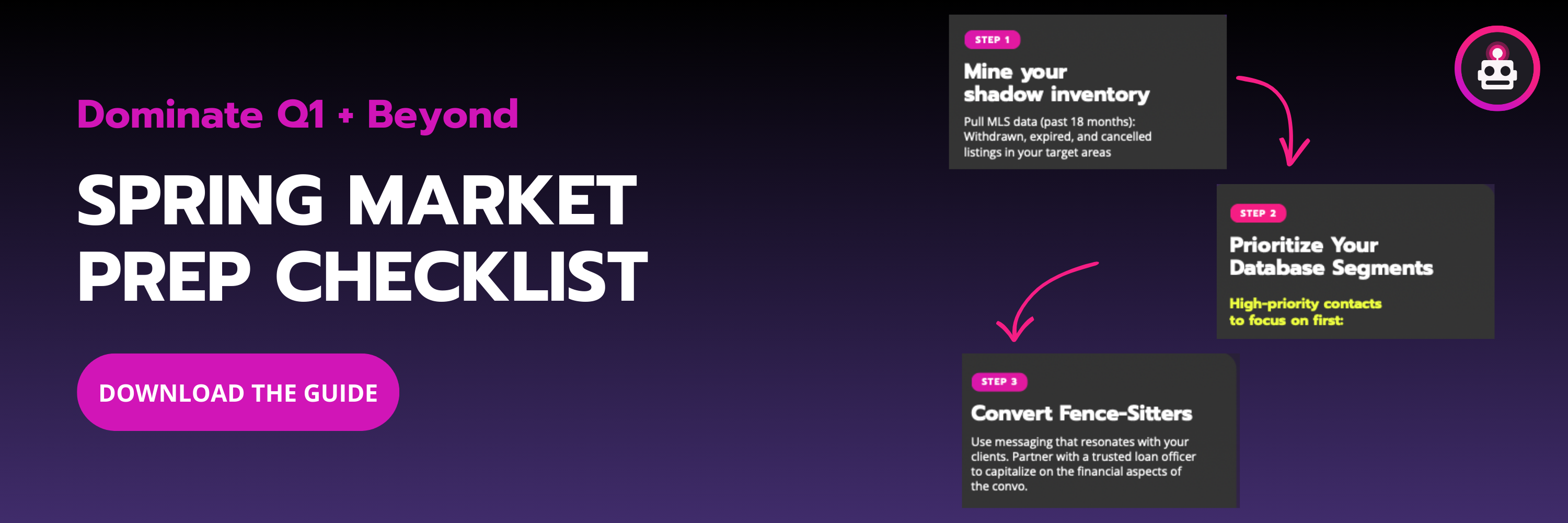
Step 2: Segment Your Database Strategically
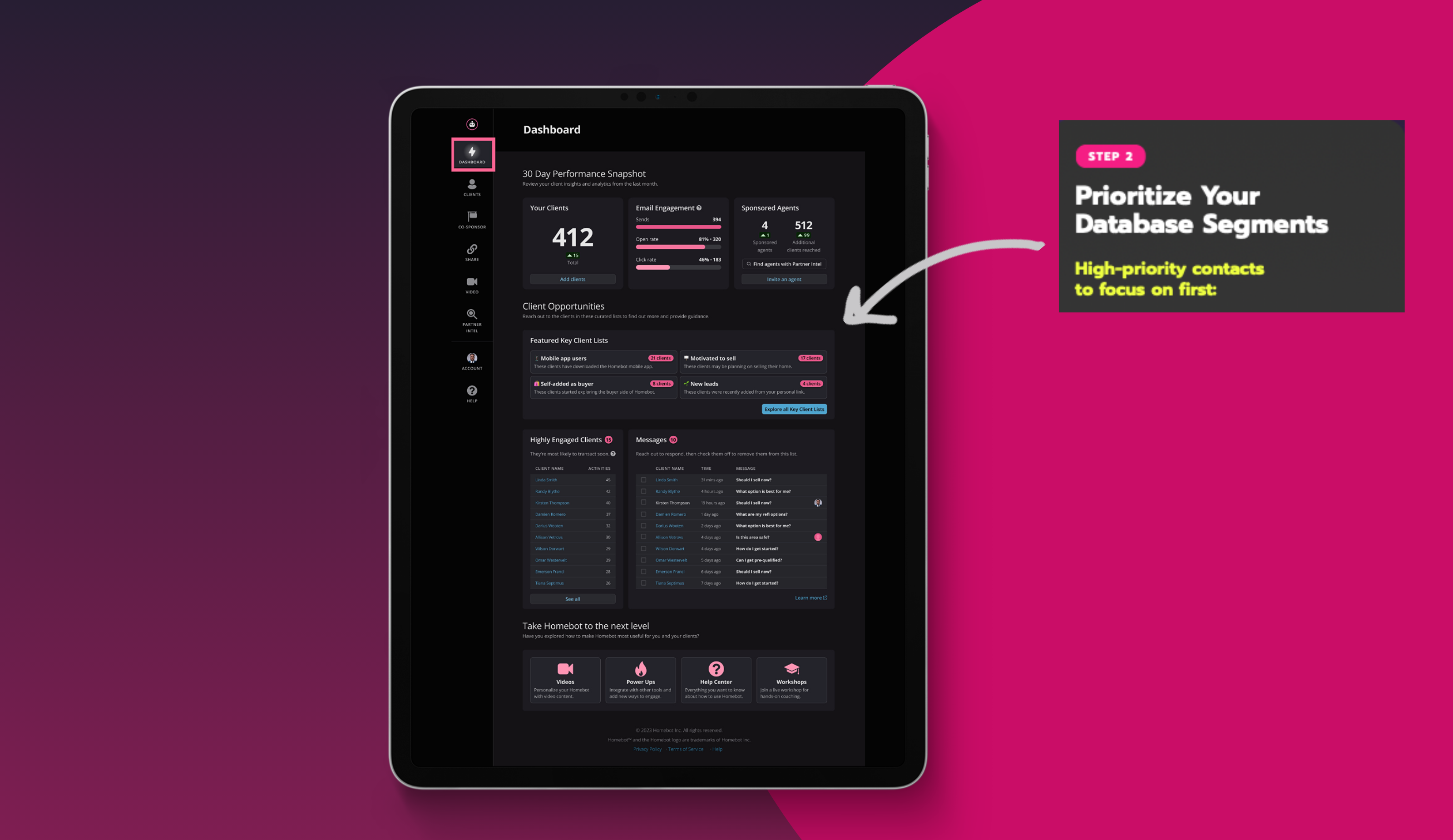
Not every contact in your database has the same likelihood of transacting in the next six months. Rather than sending blanket messages to everyone, prioritize segments that show strong buy/sell signals.
High-Priority Contact Segments
Life Event Indicators
People experiencing major life changes are statistically much more likely to move. Look for contacts who have mentioned job changes, family expansion (new baby, aging parents moving in), or downsizing considerations in the past 12 months.
These conversations often happen casually, so review your notes, past emails, and even social media interactions. Keep an ear out for comments like "we're outgrowing this place" or "considering a job offer in another city" is a major signal.
Equity-Rich Homeowners
Focus particularly on people who purchased starter homes 5-7 years ago. They've built substantial equity during a period of strong appreciation, and many are feeling squeezed in their current space. Young families often fall into this category, they bought what they could afford, started having kids, and now desperately need more room.
These homeowners may not realize how much buying power they've gained. Your role is to show them what's possible. A simple equity snapshot showing their current position versus what they could afford today often opens eyes and conversations.
Engaged Renters from 2024-25
Don't overlook renters who showed serious interest in buying. If someone attended multiple open houses, requested showings, or even got pre-approved but didn't pull the trigger, they're much warmer than a cold lead.
Many of these renters were waiting for rates to drop. Now that rates have stabilized (and likely won't drop dramatically in the near term), they may be ready to stop waiting and start building equity.
Recent Buyers from 2-5 Years Ago
This might seem counterintuitive, but recent buyers, especially those who purchased at peak rates in 2021-2022, are often reconsidering their situations. Maybe they bought in a rush during the frenzy and settled for something that wasn't quite right. Maybe their financial situation has improved and they can afford more. Maybe they bought at a 7% rate and are now in a position to move and lock in at 6%.
Don't assume someone who bought recently is settled. Market conditions have changed significantly, and so have their circumstances.
Create Segment-Specific Outreach
Once you've identified your high-priority segments, resist the urge to send everyone the same test message. Generic "thinking of buying or selling?" blasts get ignored because they show zero understanding of the recipient's specific situation.
Instead, craft targeted messaging that speaks directly to each segment's pain points and motivations. Use AI tools to help draft initial templates, but personalize them. Consider mixing up your communication methods, a text message, a quick video, or even a phone call can stand out when everyone else is sending mass emails.
Step 3: Address the Real Objections Keeping Clients on the Fence
Most agents focus on surface-level concerns, "Are rates going to drop?" or "Is now a good time?", but the real objections are deeper and more emotional. Your job is to address both the logical and emotional barriers keeping your clients from moving forward.
Why 'Waiting for Rates to Drop' Is the Riskiest Strategy
Many buyers have convinced themselves that waiting for rates to drop to 5% or below is the smart move. They're missing a critical truth: timing the rate market perfectly is nearly impossible, and waiting often means missing out on the home that checks all their boxes.
Reframe the conversation, something like this:
"It's never a bad time to purchase a home when you've found the right one. Stop waiting for rates to drop—start benefiting from market stabilization. You can refinance later when rates improve, but you can't recapture lost equity or the perfect home that sold while you waited. The best inventory goes to early movers, not to people who wait."
Partner with a trusted loan officer who can run the numbers and show buyers exactly what they can afford at current rates versus their hoped-for rates. Often, the monthly payment difference is less dramatic than they imagine, especially when you factor in equity building and home appreciation.
For Sellers Worried About Where They'll Go
This is the objection that kills more listings than anything else. Sellers love the idea of cashing out their equity, but they're paralyzed by the fear of becoming a buyer in a competitive market with limited inventory.
Address this head-on, try:
"With inventory projected to increase by 13% this year, your options are expanding significantly. We can structure flexible timing to give you an advantage, delayed closings, rent-back agreements, or contingent offers. Being an active buyer with a pending sale actually puts you in a stronger position than most other buyers. You're not just serious, you're financially qualified and motivated."
Walk them through the strategy before they list. Show them what's available in their target area right now. Help them understand that selling and buying don't have to be simultaneous, stressful events—they can be orchestrated strategically.
For "Wait and See" Contacts
Some people are just natural procrastinators, or they've convinced themselves that waiting a few more months will give them better options. Your message needs to reframe waiting as the risky choice, not the safe one.
How about this angle:
"Waiting can be risky. Sellers who list in the next 60 days will capture pent-up demand before the market gets saturated. Buyers who start searching now will see homes before competition heats up and bidding wars return. In both directions, early movers win."
Data supports this. Spring is traditionally the busiest season, which means more competition for both buyers (multiple offers) and sellers (more inventory). The sweet spot is often late winter/early spring when serious buyers are active but competition hasn't peaked yet.

Step 4: Give Them a Reason to Engage (That Actually Adds Value)
Your clients are already overwhelmed with information, much of it generic and unhelpful. To break through, you need to provide something genuinely useful, a tool or resource that helps them make better decisions on their own timeline.
Introduce Home Search as Your Value-Add
Rather than leading with "let me show you homes" or "let's schedule a meeting," offer something that puts them in control while keeping you top of mind.
Your intro message might sound like this:
"I wanted to share a tool that helps you track the market in real time as we head into spring. Home Search lets you monitor specific neighborhoods, see how your equity is growing, and explore what's in your price range as things shift. It's a smart way to stay informed while you're thinking through your next move."
Set Them Up for Success
When you introduce a tool like Home Search, take a few minutes to customize it for their specific situation:
Zip codes of interest – Don't make them guess. If they've mentioned areas they're considering, pre-load those.
Current equity position – Show them exactly where they stand financially, which often surprises homeowners who haven't checked in a while.
Ideal price point based on purchasing power – Help them understand what's realistic given their financial situation and goals.
This isn't just about the tool, it's about demonstrating that you understand their situation and you're willing to provide value even before they commit to working with you.
Let Engagement Data Guide Your Follow-Up
Here's where the strategy gets really smart. Tools like Homebot track how your clients engage with the content, which neighborhoods they're searching, how often they're checking their equity, what listings they're viewing.
This behavioral data tells you exactly when someone is moving from casual interest to serious consideration. No more guessing about when to follow up. When you see someone actively searching multiple times per week, that's your signal.
Your follow-up can be specific and natural:
"How are you liking Homebot? I noticed you've been exploring homes in [specific area] pretty actively lately, have you seen anything that caught your attention? If you want to expand your search you can always add additional zip codes "
This approach works because it's not pushy. You're not asking if they're ready to buy or sell. You're simply acknowledging that they're clearly thinking about it and offering to help them think through what they're seeing.
The Real Strategy: Early Action Beats Perfect Timing
The spring market rewards preparation, not procrastination. Start mining your shadow inventory this week, segment your database by next, and introduce value-driven tools before next month hits. While everyone else scrambles to ramp up, you'll already be in conversations with motivated clients who see you as their trusted advisor.